

TL;DR — What Is Kartra & Is It Right for You?
Kartra is an all-in-one digital business and marketing platform built for course sellers, coaches, consultants, and digital product creators who rely on funnels, email automation, and conversion-driven sales. It’s designed for marketers first, educators second. If your course or membership supports a marketing engine, Kartra fits well. If learning experience is the product, it may feel limiting.
Starting price: $52/month (Essentials, billed annually)
Free plan: No free plan; 30-day money-back guarantee
Key Features in Kartra
Funnel Builder – Visual multi-step funnels tied to pages, emails, and automations
Email & SMS Marketing – Automated sequences with tagging and behavior triggers
Landing Pages & Forms – Built-in page and opt-in builders with native integrations
Checkouts & Payments – Subscriptions, trials, order bumps, upsells, coupons
Courses & Memberships – Basic content delivery with drip access and protection
Coaching & Calendars – Paid bookings with automation and follow-ups
Automation & Tagging – Rule-based workflows for leads and customers
Affiliate Management – Built-in partner and JV tracking
Analytics & Funnel Tracking – Sales-focused reporting across funnels and emails
Bottom line: Kartra is strong when marketing drives revenue. If you want stronger course tools with excellent built-in marketing, Kajabi is a better alternative.
Try Kartra For Free
I’ve been using online course platforms with built-in marketing features for years, both for my own work and for clients. One mistake I see constantly is people judging platforms by their feature lists instead of their core job.
Some platforms exist to create strong learning experiences first, then add marketing around that. Thinkific is a good example. Others work the opposite way. Their real strength is selling, automating, and scaling digital products, with courses and memberships built to support that engine.
Kartra is firmly in the second category.
If you approach Kartra expecting a clean, learner-first course platform, you’ll likely be frustrated. But if you understand the broader problem it’s designed to solve, it can be a powerful tool.
In this review, I’ll explain what Kartra is actually good at, how its pricing works, and when it’s a smart buy (and when it isn’t).

Kartra Product Snapshot 2026
| Category | Kartra Snapshot | What This Really Means |
| Platform Type | All-in-one digital business & marketing platform | Kartra is built to sell and automate, not to be a pure learning platform |
| Core Strength | Funnels, email automation, checkouts, upsells | Revenue systems come first; content delivery is secondary |
| Starting Price | $52/month (Essentials, billed annually) | Entry pricing is reasonable, but limits appear quickly |
| Free Trial | Yes – 30-day money-back guarantee (no true free plan) | You must commit upfront; not ideal for casual testing |
| Course Creation | Built-in course areas with modules & lessons | Good enough to sell courses, not designed for learning depth |
| Membership Sites | Drip content, access rules, member portals | Strong for recurring access and gated content |
| Coaching & Consulting | Calendars, paid bookings, automations | One of Kartra’s strongest use cases |
| Digital Downloads | Secure file delivery with purchase triggers | Excellent for ebooks, templates, toolkits, and bundles |
| Marketing Tools | Email, SMS, landing pages, funnels, A/B testing | Can replace multiple standalone marketing tools |
| Automation | Behavior-based tagging and workflows | Where Kartra clearly outperforms most course platforms |
| Payments & Checkouts | Subscriptions, trials, order bumps, upsells | Designed to maximize conversion value |
| Affiliate Management | Built-in affiliate & JV system | Useful for creator-led promotions |
| Analytics & Reporting | Funnel stats, email & revenue tracking | Marketing-focused, not learner-focused analytics |
| Hosting | Pages, videos, and assets hosted internally | Convenient, but increases platform lock-in |
| Ease of Use | Powerful but complex | Expect a learning curve |
| Best For | Course sellers, coaches, consultants, digital product creators | Especially those selling via funnels |
| Not Ideal For | Educators focused on student experience | LMS-first creators will feel constrained |
Read: The best online course platforms with marketing features
What Is Kartra?
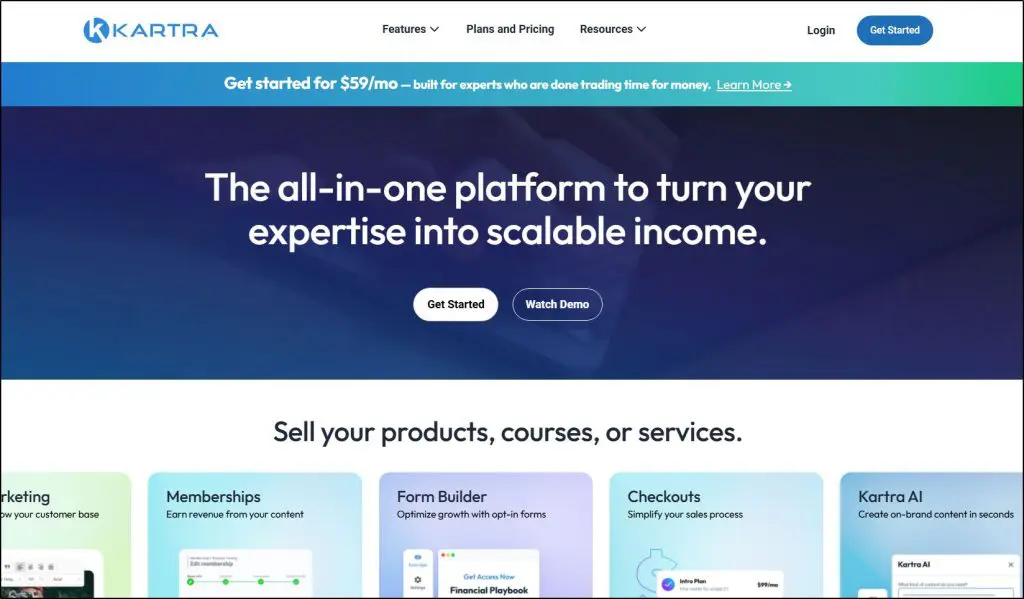
Kartra is an all-in-one digital business platform designed to help creators, coaches, and online entrepreneurs sell their products, services, and expertise from a single system.
Instead of stitching together separate tools for email marketing, landing pages, checkouts, memberships, and automation, Kartra puts everything under one roof.
At its core, Kartra is a marketing and revenue platform. It’s built for people who rely on funnels, follow-ups, and conversion optimization to grow their business.
While it includes tools for course delivery, memberships, coaching, and digital downloads, those features exist to support selling—not to compete with dedicated learning management systems.
With Kartra, you can build landing pages, capture leads, run automated email sequences, sell one-time or recurring offers, manage affiliates, and control access to content based on user behavior.
The platform is especially popular with consultants and digital product creators who want tight control over how prospects move from lead to customer.
- Funnel Builder: Create multi-step sales funnels with pages, emails, and automations connected visually.
- Email & SMS Marketing: Send broadcasts and automated sequences triggered by user behavior.
- Landing Pages & Forms: Build conversion-focused pages without external page builders.
- Checkout & Payments: Sell products with subscriptions, trials, upsells, and order bumps.
- Course Builder: Deliver structured course content inside protected member areas.
- Membership Sites: Control access to gated content with drip schedules and rules.
- Coaching & Calendars: Sell one-on-one or group sessions with built-in scheduling.
- Digital Downloads: Securely deliver files after purchase or opt-in.
- Affiliate Management: Run in-house affiliate and JV programs without third-party tools.
- Automation & Tagging: Trigger actions based on clicks, purchases, and engagement.
- Analytics & Funnel Tracking: Monitor conversions, email performance, and revenue flows.
Overall, Kartra works like a Swiss Army knife for marketers. You get a lot in one place, but you trade depth and specialization for convenience.
Read: Kajabi vs Kartra – Comparing the top all-in-one platforms
What Problem Does Kartra Solve as a Platform?
Kartra solves a problem that appears after the beginner stage but before true scale: most marketers don’t actually need enterprise-level marketing tools, but they do need everything to work together.
For beginner to intermediate marketers, Kartra’s marketing stack is more than sufficient. The email system supports tagging, sequences, behavioral triggers, and funnel-based automation.
You can build multi-step email funnels, segment users based on actions, and connect emails directly to pages, checkouts, and access rules.
That already goes well beyond what most course platforms offer and, in practice, beyond what many creators fully use for quite some time.
The same logic applies to landing pages and funnels.
Kartra’s page builder isn’t cutting-edge in terms of design flexibility or speed, but it converts well because it’s tightly integrated with the rest of the platform.
Pages, forms, emails, checkouts, and automations all share the same data layer. For most marketers, that level of integration matters far more than advanced design controls.
The limitations appear when course delivery becomes the priority.
Kartra’s course builder lacks assessments, quizzes, certificates, learning paths, and detailed progress tracking. There’s no real focus on student outcomes or engagement analytics beyond basic access and completion.
Membership areas work, but they’re shallow. For example, customization is limited, navigation is rigid, and the student experience is clearly secondary to purchase behavior.
In short, Kartra works best when marketing drives the business. When teaching quality, learner experience, or instructional design becomes the core concern, its course tools start to feel like an afterthought rather than a foundation.
Read: ClickFunnels Review | Is It A Better Alternative to Kartra?
Kartra Pricing & Free Trial (2026)
Kartra does not offer a free plan. Instead, it backs its paid plans with a 30-day money-back guarantee and a complimentary 1:1 onboarding call.
In practice, this functions as a risk-free trial: you can fully use the platform, and if it’s not a fit, you can cancel within 30 days.
Kartra currently offers four paid plans, billed monthly or annually (annual billing saves up to ~22%). The main difference between plans is usage capacity, limits, and how advanced your marketing can get.
Kartra Pricing Plans (billed annually)
- Essentials — $52/month: Entry-level plan for testing Kartra with a single product or course and basic funnels.
- Starter — $99/month: Best-value plan for serious creators who want unlimited products, courses, and full email marketing.
- Growth — $189/month: Advanced marketing plan with webinars, affiliate management, and deeper automation.
- Professional — $429/month: High-volume plan for established businesses that need higher contact limits and real-time funnel analytics.
Kartra Plan Comparison (Core Capabilities)
| Plan | Core Focus | What You Can Really Do | Who It’s For |
| Essentials | Single-offer validation | Build 1 product, 1 course/membership, basic funnels | Testing Kartra or launching a first paid offer |
| Starter | Full creator setup | Unlimited products, courses, email & SMS marketing | Most course creators & consultants |
| Growth | Marketing scale | Webinars, affiliates, advanced automations | Funnel-driven businesses and launches |
| Professional | Volume & optimization | High contact limits + real-time funnel analytics | Established teams optimizing revenue |
How Kartra Pricing Works
Kartra pricing is usage-based, not feature-based.
You get access to the same core system across plans, but upgrades unlock:
- Higher contact limits
- More team members
- More domains
- More automation power
- Deeper analytics
This is why Kartra can feel affordable at first — and expensive later. As your list grows and funnels get more complex, you naturally move up the pricing ladder.
Kartra Pros and Cons (Capabilities vs. Limitations)
| Pros (Where Kartra Is Strong) | Cons (Where Kartra Falls Short) |
| True all-in-one marketing platform – Pages, email, checkouts, memberships, automations, and analytics live in one system. | Course delivery is basic – No native quizzes, certificates, learning paths, graded assessments, or instructional design tools. |
| Solid email automation for most creators – Tagging, sequences, behavioral triggers, and funnel-based automation cover beginner to intermediate needs well. | Email builder UX feels dated – Functional but slower and less flexible than dedicated tools like ActiveCampaign or ConvertKit. |
| Tight funnel integration – Pages, emails, checkouts, and access rules all share the same data layer, which reduces tech friction. | Page builder isn’t design-first – Limited layout flexibility, slower performance, and not ideal for brand-heavy or content-rich sites. |
| Built-in checkouts and payments – Handles subscriptions, one-time payments, order bumps, and access control without third-party tools. | Analytics lack depth for teaching – Strong on sales and funnel data, weak on learner engagement and progress insights. |
| Memberships, coaching, and digital downloads work well – Good for gated content, communities, and simple training portals. | Student experience is secondary – Navigation, customization, and engagement features are rigid compared to true LMS platforms. |
| Scales marketing without integrations – Funnels, webinars, affiliates, and automation grow inside the same ecosystem. | Can feel heavy and slow – Builders and admin workflows take more clicks and patience than modern best-in-class tools. |
| Pricing replaces multiple tools – Can eliminate separate costs for email, checkout, funnel, and membership software. | Gets expensive as you grow – Contact limits and advanced tools push you into higher tiers quickly. |
Read: The best email marketing platforms for modern creators
Kartra Features: What Online Course, eLearning, and Marketing Tools Does It Offer?
Kartra’s feature set only makes sense when you view it through the lens of what the platform is trying to optimize. This isn’t a best-in-class course platform with marketing bolted on, nor a lightweight funnel tool. It’s a marketing-first system that includes course and content delivery as supporting capabilities.
Feature #1: Marketing & Lead Generation Tools
Kartra’s marketing tools are built around one core idea: launch and run complete funnels without relying on external software. In my experience, this works well for creators and small teams who want dependable automation rather than endlessly configurable systems.
Landing pages and forms are functional but not best-in-class. I’ve found the builder slower and more restrictive than dedicated page tools, especially for design-heavy brands.

However, its real strength is integration. Every form, button, and checkout is directly connected to tags, email sequences, and access rules. You trade creative freedom for fewer technical breakpoints.
Funnels and campaigns help you structure launches and evergreen flows visually. I like them for understanding user movement at a high level—what happens after a visit, opt-in, or purchase. That said, the funnel simulation and analytics are descriptive rather than diagnostic. They show flow, not deep behavioral insight.
Email marketing supports multi-step automated sequences delivered on fixed schedules, along with conditional branching using tags and triggers. You can build if-then paths, trigger sub-sequences, and automate follow-ups based on actions like purchases, clicks, or registrations.

This covers most course launches and evergreen funnels. Where it falls short is advanced journey orchestration, deep segmentation logic, and detailed automation reporting.
Overall, Kartra delivers solid, practical marketing automation, but advanced marketers will eventually feel its ceiling.
Feature #2: Sales, Funnels & Payment Infrastructure
Kartra’s sales and checkout system is one of the areas where the platform feels the most mature. I’ve found it reliable for selling digital products, courses, coaching, and memberships without needing external cart software.
You can create products with one-time payments, subscriptions, installments, trials, and free offers, all tied directly to access rules and automations.
Checkouts are flexible and conversion-focused, supporting order bumps, one-click upsells, downsells, coupons, and taxes. While the checkout design isn’t highly customizable, it’s optimized for function and integrates cleanly with email sequences and tagging.
Payment handling (refunds, cancellations, and subscription management) happens inside Kartra, which removes a lot of operational friction.
Funnels connect sales pages, checkouts, upsells, and post-purchase actions into a single flow. I’ve found this effective for standard sales funnels, but less so for complex multi-offer ecosystems. Reporting remains high-level, and attribution across multiple touchpoints is limited.
Overall, Kartra’s sales infrastructure prioritizes reliability and integration over advanced commerce flexibility, which suits most course creators and consultants but not complex eCommerce operations.
Feature #3: Courses, Memberships & Digital Products
Kartra’s course and membership tools are serviceable, but clearly secondary to its marketing engine. I’ve found them good enough for delivering paid content, but limited once teaching quality or learner experience becomes a priority.
You can create courses, memberships, and digital downloads and control access through products, tags, and automations. Content is organized into modules and lessons, delivered through a membership portal with drip scheduling, progress indicators, and basic navigation. For many creators selling video-based courses or gated content, this setup works without friction.

The limitations show up quickly for structured learning. Kartra lacks native quizzes, assessments, certificates, learning paths, and detailed progress analytics. There’s no way to measure mastery, completion quality, or engagement beyond simple access and page views. Customization of the student interface is limited, and navigation can feel rigid compared to dedicated LMS platforms.
For most marketers selling courses as part of a funnel, Kartra is sufficient. For educators focused on outcomes, pedagogy, or learner experience, it feels like a workaround rather than a foundation.
Feature #4: Automation, Analytics & Scaling Capabilities
This is where Kartra quietly does its best work—but also where advanced users start to see the ceiling.
From an automation standpoint, Kartra is strong for marketing-driven workflows. You can build rule-based automation using triggers like form submissions, purchases, tag changes, email opens, link clicks, and video engagement. These triggers can fire actions such as adding/removing tags, subscribing users to sequences, granting or revoking access, or moving leads through funnels. For most course creators and consultants, this level of automation is more than enough and often underused.
However, Kartra’s automation logic is structured, not free-form. You’re not building complex visual logic trees with deeply nested conditions the way you would in dedicated tools like ActiveCampaign or HubSpot. It’s powerful, but opinionated.
Analytics follow a similar pattern. You get solid visibility into funnels, emails, pages, checkouts, and revenue, but reporting is largely descriptive, not exploratory.

There’s limited custom reporting and no true cohort or learning analytics. Scaling is possible—but only as long as marketing, not data science or instructional depth, remains the core driver of the business.
Who Is Kartra Right For?
Kartra is right for marketers first, educators second.
It’s a strong fit for course creators, consultants, coaches, and service-based businesses whose growth depends on funnels, email follow-ups, and conversion flows more than on deep teaching mechanics. If your business is driven by lead generation, sales pages, webinars, and automated email sequences—and your course or membership is part of that funnel—Kartra fits naturally.
It also works well for solo creators and small teams who want one system instead of stitching together five tools. If you value speed, tight integration, and fewer moving parts over best-in-class depth, Kartra delivers.
Kartra is especially suitable if:
- Your course is video-led and doesn’t rely on assessments or certifications
- You sell coaching, memberships, or digital products alongside courses
- You want marketing automation without enterprise complexity
- You’re comfortable trading design and LMS depth for operational simplicity
If marketing drives revenue, Kartra makes sense.
Who Is Kartra Not For?
Kartra is not the right platform if course quality, learner experience, and instructional depth are the core of your business.
If you run an education-first course business, Kartra’s limitations become hard to ignore.
There are no native quizzes, assessments, certificates, learning paths, or meaningful student progress analytics.
Course navigation is functional but rigid, and the overall student experience feels secondary to the sales flow. If teaching outcomes, completion rates, or structured learning matter to you, Kartra will feel restrictive.
In these cases, a platform like Kajabi is a better fit. Kajabi offers stronger course creation tools—quizzes, certificates, better lesson organization, and a more polished student interface—while still providing built-in email marketing, landing pages, offers, and automations.
It strikes a better balance for creators who want real e-learning features without giving up marketing power.
Kartra is also not ideal for businesses that need advanced CRM-level marketing or deep automation logic. While its automation is strong for most creators, teams that require complex branching workflows, advanced reporting, or sales pipeline management will outgrow it.
Finally, if design flexibility and modern UX are top priorities, Kartra may disappoint. It works, but it doesn’t feel contemporary.
If your business is education-led or demands deeper learning tools, Kartra isn’t the right foundation.
Kartra vs Popular Alternatives (Quick Reality Check)
When Kartra feels limiting, here are the best alternatives for different use cases.
| Platform | Best For | Why It’s a Strong Alternative | Where It Falls Short |
| Kajabi | Course creators who want marketing + strong learning experience | Better course structure, quizzes, certificates, cleaner student UX, solid built-in marketing | Automation and funnel logic not as deep as Kartra. But still pretty strong |
| Thinkific | Education-first businesses and online schools | Excellent course delivery, assessments, learning paths, student analytics | Marketing tools are limited; requires external email/funnel tools |
| ClickFunnels | Funnel-driven offer launches | Fast funnel creation, strong upsells and conversion flow | Weak course and membership experience; limited long-term delivery |
| ActiveCampaign + LMS | Advanced email and automation-led businesses | Best-in-class automation, segmentation, and behavioral logic | Not all-in-one; requires separate LMS and checkout setup |
| GoHighLevel | Agencies and CRM-driven businesses | Strong CRM, pipelines, automation, SMS, client management | Course hosting is basic and secondary; not built for teaching |
Final Verdict: Should You Use Kartra For Digital Products?
Kartra makes sense if your business sits in the middle ground between simplicity and scale. It’s a practical choice for creators who want to sell multiple digital products without stitching together half a dozen tools.
You trade depth for cohesion, and for many businesses, that’s a smart trade.
Where Kartra struggles is when priorities shift toward education quality or advanced systems thinking. It won’t grow into a world-class LMS or an enterprise CRM.
But if your goal is to launch, sell, optimize, and manage digital products from one place without technical overhead, Kartra remains a viable, if opinionated, platform choice.
Frequently Asked Questions (FAQs)
1. Is Kartra a true LMS or just a marketing platform with courses?
Kartra is not a true LMS. It includes course and membership delivery, but it lacks core LMS features like quizzes, certificates, learning paths, and learner analytics. It’s best described as a marketing platform that can deliver courses, not an education-first system.
2. Can Kartra replace tools like ActiveCampaign or HubSpot?
For most creators and small businesses, yes. Kartra can replace basic email automation and funnel workflows. However, it cannot match the depth of CRM pipelines, reporting, or complex automation logic offered by ActiveCampaign or HubSpot.
3. Is Kartra good for selling online courses?
Kartra works well for selling courses as part of a funnel, especially video-based courses, coaching programs, and memberships. It is less suitable for structured education, certifications, or academic-style programs.
4. Does Kartra support quizzes, tests, or certificates?
No. Kartra does not offer native quizzes, graded assessments, certificates, or credentialing. Any evaluation or certification workflows require external tools or manual workarounds.
5. How good is Kartra’s email marketing compared to dedicated tools?
Kartra supports tagging, sequences, conditional automation, and behavioral triggers. This covers most use cases for course creators and consultants. Dedicated tools offer better UX, reporting, and advanced logic, but Kartra’s email system is sufficient for most non-enterprise needs.
6. Can Kartra handle webinars and live launches?
Yes, on higher plans. Kartra supports webinars with attendee limits and automation tied to registration, attendance, and follow-ups. It’s suitable for standard launches but not advanced virtual event production or large-scale summits.
7. Is Kartra good for coaching and consulting businesses?
Yes. This is one of Kartra’s strongest use cases. Calendars, paid bookings, subscriptions, and automation make it well suited for 1-on-1 coaching, group programs, and retainers.
8. Does Kartra lock you into its ecosystem?
Yes, to an extent. Because pages, emails, memberships, videos, and automations are all hosted inside Kartra, migrating away requires planning. This isn’t unique to Kartra, but the all-in-one convenience comes with platform lock-in.
9. Can you migrate courses from Kartra to another platform?
Content can be migrated manually (videos, text, downloads), but students, progress data, and automation logic do not transfer cleanly. Expect a rebuild if you move to another LMS.
10. Is Kartra suitable for large teams or agencies?
Kartra can support small teams, but it is not agency-first. Permissions, workflows, and client separation are limited compared to platforms like GoHighLevel or HubSpot.
11. How does Kartra compare to Kajabi for course creators?
Kajabi offers better course structure, learner experience, and education tools, while Kartra offers stronger funnel control and automation. Kajabi is better for education-led businesses; Kartra is better for marketing-led businesses.
12. Does Kartra charge transaction fees?
Only on the Essentials plan (5%). Starter and higher plans have 0% transaction fees. Payment processor fees still apply regardless of plan.
13. Is Kartra beginner-friendly?
Kartra is powerful but not beginner-light. There is a learning curve, especially around funnels and automation. It’s best for users willing to invest time upfront to understand how systems connect.
14. Can Kartra replace WordPress for course websites?
For funnel-based businesses, yes. For content-heavy sites, blogs, or SEO-driven publishing, WordPress is still a better choice. Kartra is optimized for conversion, not long-form content management.
15. What happens when you outgrow Kartra?
Most businesses outgrow Kartra in one of two ways:
- they need better learning tools, or
- they need deeper automation and CRM logic.
At that point, switching to a dedicated LMS or advanced marketing platform becomes necessary.
Table of Contents


Kartra is a good platform for business but i think Vonza is better because it has more tools you need to run your business online . it is very easy to use and cheap for beginners